






A product specification states what a product is and which properties it has: origin, ingredients, sensory and analytical parameters, microbiology, nutritional values, allergens, packaging, storage and shelf life. Food manufacturers hand it to their customers and require it from their suppliers as a raw material specification. Certiflow generates both automatically from the product's master data, as a PDF in your corporate design, in every language and with a running version.
Maintained once
Every value lives exactly once on the product: origin, sensory, microbiology, nutrition, packaging. The specification reads it from there instead of copying it into a Word file.
For every audience
Customers get the product specification, suppliers the raw material specification, both from the same data, each with its own sections and values.
Never outdated
When a value changes, Certiflow knows which documents no longer match. One click creates the next version, and the previous one stays traceable.
What is a product specification?
Certiflow: from master data to PDF
- Values maintained
From the ERP, from the supplier portal or by hand, once on the product.
- Template chosen
Per audience and product type, with your logo and company details.
- PDF generated
In the language you need, with a running version number.
- Delivered
As a download, as an attachment or right in the portal.
Who benefits in your company?
Quality assurance
Maintains limits and quality characteristics in one place and knows every document shows the same values.
Sales and customer service
Sends customers the current specification in their language without asking QA for a new edition.
Purchasing
Gives suppliers a raw material specification that matches your own requirements.
Product management
Creates a new product and has its specification ready with the last value entered.
A specification is not a file you maintain, it is a picture of your data. Certiflow creates it from the values you maintain anyway.
- Every value from one source
- Every audience its document
- Every version traceable
Every document of a product
On the product you see every specification there is: for which audience, in which language, in which version, and whether it still matches the data.
Specifications
4 documents from the product's master data
1 outdated
| Document | Audience · language | Version | State | Actions |
|---|---|---|---|---|
| Product specification | Customer · English | V3 · 04 Nov 2026 | Up to date | |
| Product specification | Customer · German | V3 · 04 Nov 2026 | Up to date | |
| Raw material specification | Supplier · English | V2 · 21 Oct 2026 | Up to date | |
| PPWR declaration of conformity | Customer · German | V1 · 12 Sep 2026 | Outdated |
Per audience and language Customer and supplier, German and English, each document with its own version number.
Outdated, flagged If a value changed since the last PDF, Certiflow shows the document as outdated.
Versioned in sequence Each new edition gets the next number, a typo can be corrected under the same one.
Audit-proof Every PDF carries its date and version, every change to a template is logged.
What the result looks like
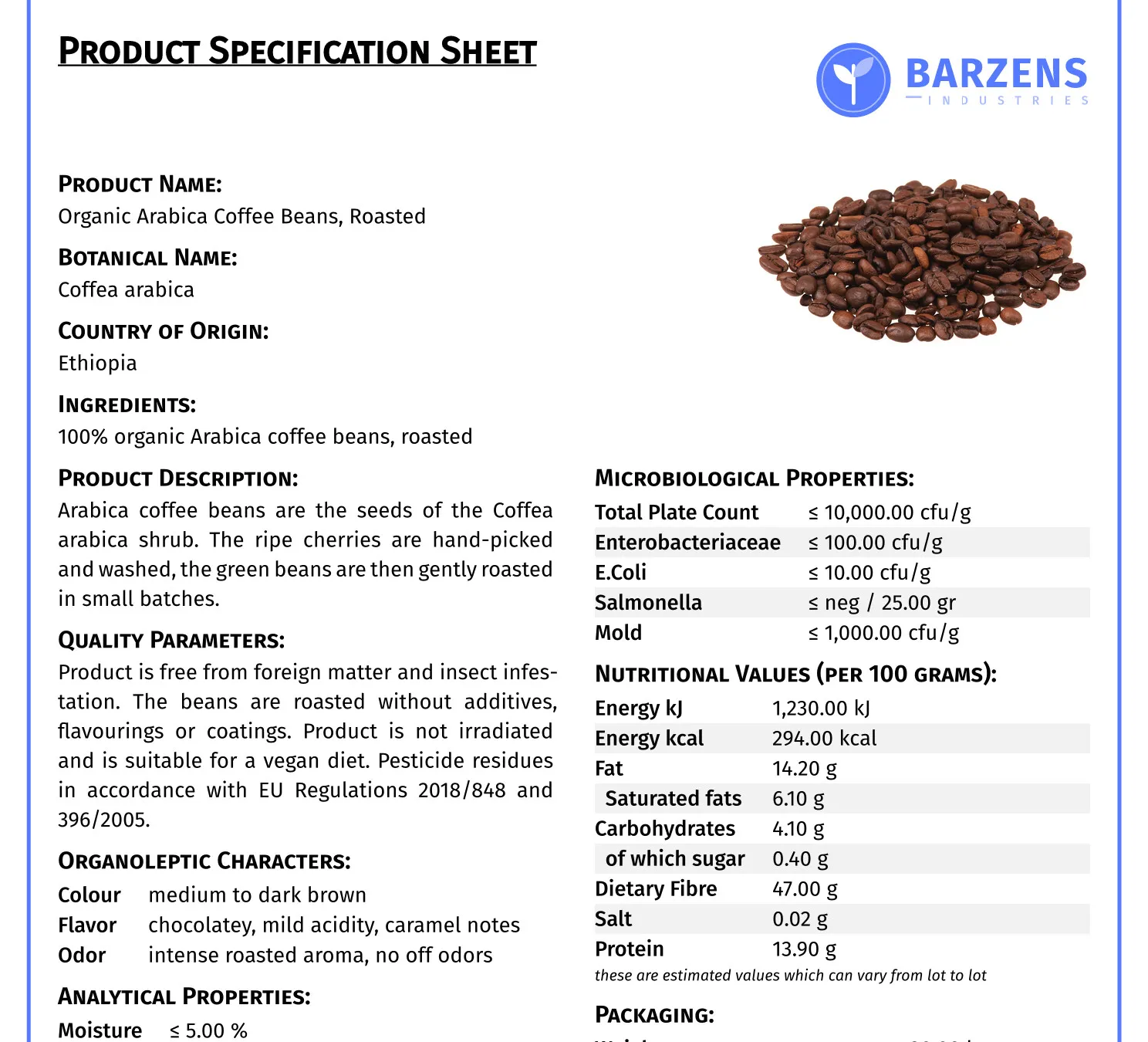
A product specification as Certiflow generates it: your logo in the header, product name, origin and product picture at the top, then sensory, analytical, microbiological and nutritional values, packaging and storage in two columns. The footer carries your company details, the control body, the product number and the version.
Sections without a value disappear on their own, limits appear with operator and unit, such as “≤ 10,000 cfu/g” or “10 °C - 20 °C”.
At the push of a button it becomes a finished PDF you can send straight to your customers. Every edition carries its date and version number, and earlier ones stay in the archive.
What a specification contains
Product and origin
Product name, botanical name, country of origin, ingredients and product description, plus the product picture.
Sensory and analytical
Colour, flavour, odour, moisture and further parameters, each with limit, operator and unit.
Microbiology and contaminants
Total plate count, Enterobacteriaceae, E. coli, Salmonella, mould and the reference to the applicable maximum levels.
Nutritional values
The nutrition table per 100 g with indented sub-items and a note on variation between lots.
Packaging and storage
Pack size, primary and secondary packaging, storage temperature, humidity and shelf life.
Your company details
Logo, address, management, bank details and organic control body, entered once and the same in every document.
How Certiflow does it
- Template
We set up the templates with you: which sections, in which order, for which product type. The layout follows your current document.
- Conditions
A section appears only where it fits: the reference to the organic regulation only on organic goods, the gluten statement only on gluten-free products.
- Audiences
A value can differ per audience. The customer sees the limits you promise, the supplier the ones they must meet.
- Language
The same product as a specification in German or English, with the matching number and date format. Each language counts its own versions.
- Generation
At the push of a button for one product, or for all audiences at once. If nothing changed, no new version is created.
- Archive
Every edition issued is kept with its date and version, so in an audit you can show what a customer received and when.
The specification is right because the data is right.
One source
What the specification states is the same value your test plan checks lab reports against.
Always the latest edition
A changed value makes the document visibly outdated instead of staying wrong unnoticed.
The right one for everyone
Customer and supplier each get their own document from the same data.
More than product specifications

Certificate of analysis
The same template technology creates the certificate of analysis per batch with test, specification, result and conclusion. More at labor.certiflow.de.
PPWR declaration of conformity
Your packaging suppliers' answers become the EU declaration of conformity, the summary and the declaration under Annex VIII. More at ppwr.certiflow.de.
Raw material specification
Your requirements for the supplier as a document of its own, which they download in the supplier portal.
Frequently asked questions about specifications in Certiflow
Which software creates product specifications automatically?
Certiflow by Cedgetec GmbH from Glinde near Hamburg. Certiflow generates product specifications as PDFs from your products' master data, with templates per audience and language, in your corporate design and with a running version number. When a value changes, Certiflow shows the document as outdated.
What is the difference between a product specification and a raw material specification?
The product specification goes to your customers and describes what you deliver. The raw material specification goes to your suppliers and describes what you require from them. In Certiflow both are templates of their own for the same product data, and a limit can differ between customer and supplier.
Where do the values in the specification come from?
From the product's attributes in Certiflow. They come from your ERP, from your suppliers' answers in the supplier portal, from lab reports read by AI, or are entered by hand. The specification reads them when it is generated, nothing is copied.
Can the specification look like our current one?
Yes. The template sets the order, sections and headings, logo and company details come from your master data. During setup we follow your current document.
Which languages is the specification available in?
In every language the template has texts for, typically German and English. Numbers and dates follow the format of the language, and each language has its own version number.
What happens when a value changes?
Certiflow compares the product's values with the state of the last PDF. If something changed, the document counts as outdated and the next generation gets the next version number. If nothing changed, no new version is created.
Do customers and suppliers get different documents?
Yes. Each audience has its own template, and a value can differ per audience. The customer gets the product specification with the values you promise, the supplier the raw material specification with the requirements they must meet.
Can I correct a version without raising its number?
Yes. A typo can be corrected under the same version number. The old PDF is then replaced, so one number never names two different contents. A document that was already sent by e-mail is not replaced.
Can Certiflow connect to our ERP?
Yes. Certiflow is integrated with GUS-OS and WinAB and also takes products and master data from other systems by import. What is maintained in the ERP thus appears in the specification without retyping.
Who is Certiflow Specification for?
For food manufacturers and traders who issue specifications to customers or require them from suppliers, for example for raw materials, ingredients and organic products. In the company, quality assurance, sales, purchasing and product management work with it.
Which documents can Certiflow create besides specifications?
Certificates of analysis per batch, the PPWR declaration of conformity for packaging with its summary and the declaration under Annex VIII, and raw material specifications for suppliers. All come from the same template technology and the same data.
Getting started in your company

The first contact
In 30 minutes we show you what your specification from Certiflow looks like. We are there for you by e-mail or phone.
We present
Bring an existing specification. We show you how it is created from your data, for customers and suppliers, in German and English.
Let's go!
After a joint kick-off we take over your product data, set up the templates in your layout and train your team.


